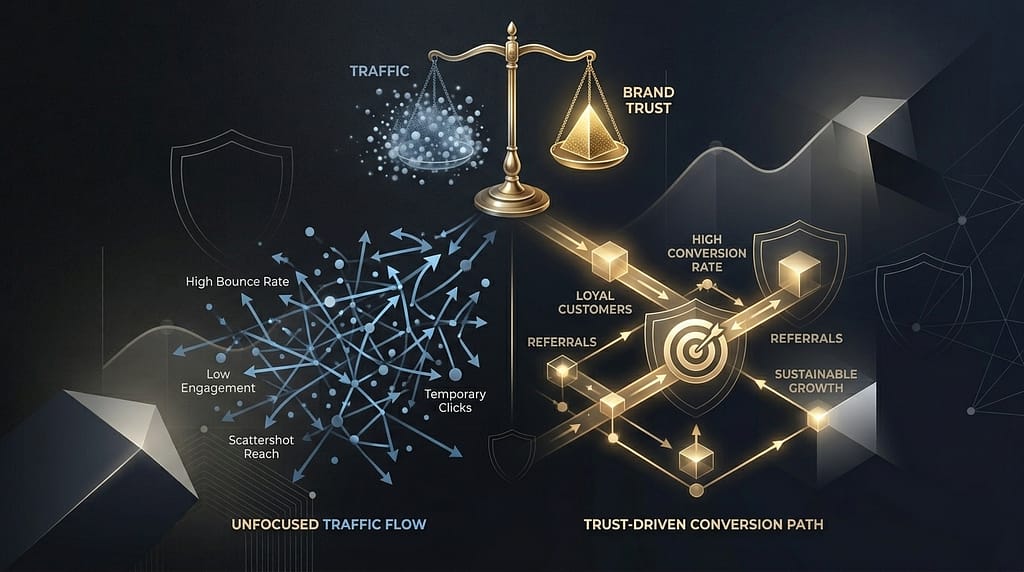
Why Brand Trust Is
More Valuable Than Traffic
Traffic gets you visitors. Trust gets you customers, advocates, and a business that compounds in value over time. Here’s why the most successful brands in 2026 invest in trust — not just clicks.
The Traffic Trap: Why More Visitors Doesn’t Mean More Business
For years, the marketing world has been obsessed with a single metric: traffic. More visitors. More impressions. More reach. Entire agencies have been built around delivering clicks, and entire marketing budgets have been poured into chasing numbers that look great in a dashboard but rarely reflect what actually matters — real, sustained business growth.
But in 2026, the cracks in the traffic-first model are impossible to ignore. Average e-commerce conversion rates sit between 1–3%. That means up to 99% of the people landing on your website leave without taking any meaningful action. For businesses spending aggressively on paid traffic, those numbers represent an enormous and painful gap between investment and return.
According to Edelman’s Trust Barometer, 81% of consumers say they need to trust a brand before they will make a purchase — making trust the single greatest predictor of conversion, not traffic volume.
The traffic trap works like this: businesses invest heavily to bring people to their site. Those visitors arrive with no prior relationship with the brand. They feel uncertainty. They leave. The business invests more to bring more people. The cycle continues — and the cost of acquisition rises while trust remains unbuilt.
Businesses that rely purely on traffic generation spend 5–7× more on customer acquisition than brands with strong trust foundations. Without trust, you’re essentially renting attention at full price and converting it at a fraction of its potential.
Trust is what makes traffic valuable. It is the multiplier — the variable that determines whether the visitors you attract become customers, or simply statistics. And unlike traffic, trust compounds. Every positive interaction, every delivered promise, every authentic review adds to a reservoir of credibility that pays dividends for years.
Traffic vs. Brand Trust: A Side-by-Side Reality Check
To understand why brand trust outperforms traffic as a long-term business asset, it helps to look at what each one actually delivers — and what it costs to maintain.
What Traffic Gives You
- Vanity metrics that look good in reports
- Visitors with no brand relationship
- High bounce rates and low dwell time
- 1–3% average conversion rates
- Rising acquisition costs over time
- Zero value when ad spend stops
- Shallow customer relationships
- Vulnerable to algorithm changes
What Brand Trust Gives You
- Word-of-mouth referrals — free traffic
- Repeat customers with high lifetime value
- Lower bounce rates, deeper engagement
- Significantly higher conversion rates
- Decreasing acquisition costs over time
- Self-sustaining brand equity
- Loyal advocates who defend your brand
- Resilience against market shifts
The key insight here is that traffic is a rented asset. The moment you stop paying for ads or the algorithm shifts, your traffic disappears. Brand trust, on the other hand, is an owned asset. It lives in the minds of your customers, and it works for you around the clock — without a single additional dollar spent.
“A brand is no longer what we tell the consumer it is — it is what consumers tell each other it is. Trust is the infrastructure on which that conversation is built.”
— Scott Cook, Co-Founder of IntuitThe 6 Business Outcomes Only Brand Trust Can Deliver
Brand trust does something traffic simply cannot: it changes the quality of every customer relationship. Here are the six tangible, measurable outcomes that trusted brands experience — and traffic-chasing brands miss entirely.
Repeat Purchases & Loyalty
Trusted customers return. Research shows returning customers spend 67% more than new customers and are 5× cheaper to retain than acquire. Loyalty is built entirely on trust — not traffic.
Word-of-Mouth Referrals
92% of people trust recommendations from friends and family over any form of advertising. Trusted brands generate a constant stream of organic referrals — effectively free, high-converting traffic.
Higher Conversion Rates
Trusted brands consistently convert at 3–5× the rate of unknown brands, even with identical traffic volumes. Trust removes the friction that stops visitors from becoming buyers.
Crisis Resilience
When trusted brands face challenges, their customers give them the benefit of the doubt. A loyal customer base is the most powerful buffer against negative press, market shifts, or public criticism.
Premium Pricing Power
Trusted brands command higher prices. Consumers willingly pay a premium for brands they trust — reducing price sensitivity and dramatically improving profit margins without increasing marketing spend.
Brand Advocacy
Highly trusted brands create advocates — customers who actively promote your brand without being asked or incentivized. These advocates are worth more than any paid influencer campaign.
How Brand Trust Impacts Key Business Metrics
What Actually Builds Brand Trust in 2026
Brand trust is not built through a single campaign or a viral moment. It is built through a consistent accumulation of small promises kept, authentic experiences delivered, and genuine value demonstrated over time. Here is what the research shows actually moves the needle.
Top Drivers of Consumer Brand Trust in 2026
Trust research consistently shows that consistency is the single most powerful trust builder. A brand that delivers the same quality experience — across every touchpoint, every time — builds trust exponentially faster than one that occasionally delivers excellence but unpredictably disappoints.
8 Proven Strategies to Build Brand Trust That Outlasts Any Traffic Campaign
Building brand trust is a deliberate, strategic process. These eight strategies are used by the world’s most trusted brands — and they are fully accessible to businesses of every size.
Be Radically Consistent Across Every Touchpoint
Trust is built through repetition. Your brand voice, visual identity, customer experience, and values must be consistent whether a customer encounters you on social media, your website, in an email, or in person. Inconsistency — even small inconsistencies — signals unreliability, and unreliability is the enemy of trust. Audit every customer touchpoint annually and ensure they all tell the same story.
Make and Keep Specific, Measurable Promises
Trust is built on kept promises — not vague marketing language. Replace generic claims like “great customer service” with specific, verifiable commitments: “We respond to every inquiry within 2 business hours.” Then deliver on that promise without exception. Specific promises that are consistently kept build far more trust than broad value statements that can’t be measured or verified.
Prioritize Review Generation and Authentic Social Proof
88% of consumers trust online reviews as much as personal recommendations. Build a systematic, always-on process for generating authentic customer reviews across Google, Trustpilot, and industry-specific platforms. Respond to every review — positive and negative — professionally and promptly. Your response to criticism is often more trust-building than the praise you receive.
Publish Expert-Level Content That Genuinely Helps
Brands that educate their audience without constantly selling build extraordinary trust. Create content that answers the real questions your ideal customers are asking — even questions about competitors, limitations, or honest comparisons. This kind of transparent, expert-level content positions your brand as the most credible voice in your industry and earns trust that no paid ad can replicate.
Embrace Radical Transparency
Modern consumers are more sophisticated than ever — they can detect corporate speak instantly, and it destroys trust. Be transparent about your pricing, your processes, your mistakes, and your values. If something goes wrong, own it publicly and explain what you’re doing to fix it. Brands that communicate openly during difficult moments consistently emerge with stronger trust than before the challenge arose.
Showcase Real Results With Specific Case Studies
Generic testimonials are weak. Specific, detailed case studies with real names, real numbers, and real outcomes are extraordinarily powerful trust signals. Document your customer success stories in depth — including the challenge, your solution, and the measurable results achieved. This form of social proof removes the risk a potential buyer feels and replaces it with confidence.
Build Thought Leadership Through Media and PR
When credible, third-party media outlets write about your brand or quote your leadership, it provides a form of trust validation that self-promotion simply cannot achieve. Develop a consistent media relations strategy — contribute expert commentary, pitch unique data stories, and build relationships with journalists in your industry. Third-party validation is one of the fastest ways to accelerate brand trust at scale.
Invest in Post-Purchase Customer Experience
Most brands invest heavily in the journey to the first purchase and almost nothing in what happens after. This is the single biggest missed opportunity in trust building. A customer’s post-purchase experience — how they’re onboarded, supported, followed up with, and rewarded for loyalty — determines whether they become a repeat buyer, an advocate, or someone who quietly moves to a competitor. Design your post-purchase journey with the same intentionality as your sales funnel.
Start tracking trust-indicating metrics alongside traffic: Net Promoter Score (NPS), review volume and average rating, repeat purchase rate, referral rate, and brand mention sentiment. These numbers tell you far more about the long-term health of your business than sessions and impressions ever will.
The Complete Brand Trust Signal Checklist
These are the specific, visible trust signals that convert skeptical visitors into confident buyers. Audit your brand against this list and identify the gaps:
- Verified Customer Reviews — A consistent, growing stream of genuine reviews on Google, Trustpilot, or industry platforms with professional responses to each.
- Detailed Case Studies — Real customer success stories with specific names, challenges, outcomes, and measurable results that demonstrate proven capability.
- Media & Press Mentions — Logos of credible publications, media outlets, or industry bodies that have featured or referenced your brand.
- Transparent Pricing Pages — Clear, honest pricing information without hidden fees or vague “contact us for pricing” deflection that increases buyer anxiety.
- Real Team & Leadership Profiles — Authentic “About” pages with real names, photos, backgrounds, and credentials that humanize your brand.
- Clear Privacy & Return Policies — Easy-to-find, plain-language policies that demonstrate respect for customers and remove purchase risk.
- Active, Engaged Social Presence — Consistent, authentic social media presence that responds to comments, shares genuine content, and shows real personality.
- Industry Certifications & Awards — Verified credentials, accreditations, or industry recognition that independently validate your expertise and quality.
- Free Value Content & Resources — Guides, tools, templates, or educational content that demonstrates expertise and generosity without requiring a purchase.
- Honest, Specific Guarantees — Clear, specific guarantees that put the risk on your brand rather than the customer — the ultimate expression of confidence in your product.
Frequently Asked Questions About Brand Trust vs. Traffic
Why is brand trust more valuable than traffic?
Brand trust converts visitors into loyal customers and advocates. High traffic without trust results in high bounce rates and low conversions. Trusted brands enjoy repeat purchases, word-of-mouth referrals, and higher lifetime customer value — outcomes that traffic volume alone can never reliably deliver. Trust is also a compounding asset: the more you build, the more it grows on its own.
Can a business have both high traffic and high brand trust?
Absolutely — and that combination represents the ultimate competitive position. The key insight is that trust should come first. Build trust, and traffic becomes exponentially more valuable. When you drive high volumes of traffic to a brand people already respect, conversion rates soar, acquisition costs fall, and word-of-mouth compounds your reach organically. Traffic without trust is a leaky bucket; trust makes the bucket airtight.
How long does it take to build brand trust?
Meaningful brand trust can be built within 6–12 months through consistent, deliberate action — but the compounding benefits grow for years. Some trust signals, like acquiring genuine reviews and publishing expert content, can show measurable impact within 60–90 days. Trust is not built through a single campaign; it is the cumulative result of every customer interaction you have ever had.
How do I measure brand trust?
Key brand trust metrics include: Net Promoter Score (NPS), customer review volume and average rating, repeat purchase rate, referral conversion rate, branded search volume growth, brand mention sentiment across social and web, and customer lifetime value (CLV). Track these alongside traffic metrics and you will quickly see which investments are actually building sustainable business value.
Is brand trust relevant for small businesses?
Brand trust is arguably more important for small businesses than large ones. Small businesses cannot outspend large competitors on traffic acquisition — but they can out-trust them. A small local business with hundreds of authentic 5-star reviews, genuine community engagement, and a reputation for keeping its promises will consistently outperform a larger brand with more traffic but less credibility. Trust is the great equalizer.
Stop Renting Attention. Start Earning Trust.
Every dollar you spend on traffic without building trust is a dollar rented, not invested. The moment you stop paying, the attention disappears. But every effort you make to build genuine brand trust — through consistency, transparency, real expertise, and authentic relationships — creates an asset that appreciates over time and works for your business even when you sleep.
The most respected brands in the world are not the ones who shouted the loudest or spent the most on advertising. They are the ones their customers chose to trust — and kept choosing to trust, over and over again. That level of loyalty cannot be bought with a media budget. It must be earned, one kept promise at a time.
In 2026 and beyond, the businesses that win will be the ones that understand a simple but profound truth: trust is not a soft, fuzzy ideal — it is the hardest, most durable competitive advantage a brand can build.
Traffic tells you how many people showed up. Trust tells you how many people stayed, came back, and brought their friends. Build the thing that compounds. Build brand trust — and let it do the heavy lifting of growing your business for years to come.
Pick one trust signal your brand is missing from the checklist above and implement it this week. One genuine review request campaign. One transparent case study. One honest pricing page update. Trust is built in small, consistent steps — and it starts with the next action you take.
Consider reading our other helpful posts for more expert insights, practical tips, and strategies to grow your business faster. Read More Blogs