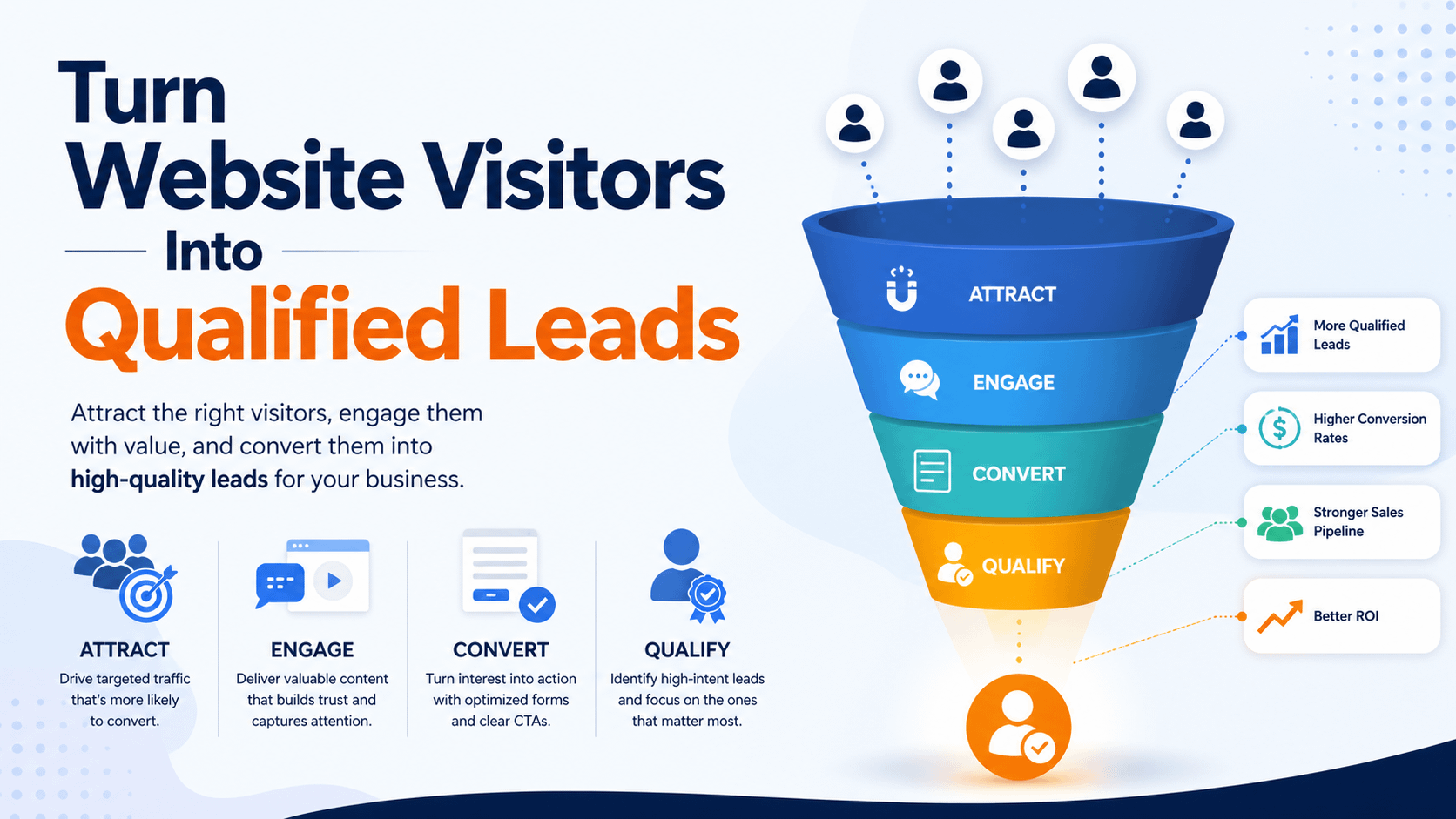
How to Turn Website Visitors
Into Qualified Leads
Getting traffic is only half the battle. The real win is converting anonymous visitors into high-intent, qualified leads who are ready to buy. Here is the complete 2026 playbook — built on strategy, not guesswork.
Why 98% of Website Visitors Leave Without Becoming Leads
Here is the uncomfortable reality: the average website converts just 2.35% of its visitors into leads. For every 1,000 visitors you drive to your site, roughly 976 of them leave with no record, no follow-up opportunity, and no connection to your business. For businesses investing in paid traffic, this represents an enormous, largely invisible waste of budget.
The root cause is almost never bad traffic. It is a failure of conversion architecture — the deliberate design of systems, content, and pathways that guide a visitor from anonymous browser to identified, qualified prospect. Most websites are built to inform. They need to be built to convert.
The average website visitor-to-lead conversion rate across industries. Top-performing lead generation websites convert at 11.45% or higher — a 5× difference achieved entirely through strategic conversion optimization, not more traffic spend.
Understanding why visitors leave without converting is the first step. The most common reasons are: no clear next step offered, no compelling reason to share contact information, generic calls-to-action that don't match visitor intent, slow page load speed, lack of trust signals, and no lead magnet worth exchanging an email address for.
Investing more in traffic without first optimizing your conversion rate is like filling a leaky bucket faster. A business converting at 1% that doubles its traffic gets 2× more leads. The same business that optimizes to 4% gets 4× more leads from the exact same traffic — at zero additional acquisition cost.
Total Visitors
Anonymous traffic from all sources
100%Engaged Visitors
Scroll 50%+ or visit 2+ pages
~30%Lead Captures
Submit a form or CTA action
~5%Qualified Leads
Meet ICP — ready to engage sales
~2%Website Visitor vs. Qualified Lead: Understanding the Critical Difference
Not all leads are equal — and not all website visitors are leads. Before building your conversion system, it is essential to understand the distinction between a raw visitor, a captured lead, and a qualified lead. Conflating these three stages is one of the most common and costly mistakes in B2B and B2C lead generation.
What Unqualified Looks Like
- Downloaded a freebie but has no real need
- Wrong industry, budget, or geography
- No decision-making authority
- Timeline is "someday, maybe"
- Engaged with content but not with offer
- No response to follow-up sequences
- Inflates your lead numbers with no revenue
What Qualified Looks Like
- Has a clear, specific, urgent problem
- Fits your ideal customer profile (ICP)
- Has the budget and authority to buy
- Active timeline — decision in 30–90 days
- Engaged with high-intent content
- Responds to follow-up and asks questions
- Represents real, closeable revenue potential
The goal of your website conversion system is not to capture as many email addresses as possible. It is to capture the right email addresses — from visitors who match your ideal customer profile and are genuinely positioned to buy. A smaller number of qualified leads is always more valuable than a large list of cold, disinterested contacts.
"The quality of your leads determines the quality of your revenue. Building a qualification layer into your lead capture process is not optional — it is the difference between a sales pipeline and a contacts spreadsheet."
— HubSpot State of Marketing Report, 2026The 6 Conversion Drivers That Turn Cold Visitors Into Warm Leads
Before diving into specific tactics, every high-performing lead generation website is built on six foundational conversion drivers. Get these right and every tactic you implement on top of them multiplies in effectiveness.
Intent-Matched Offers
Your lead capture offer must align precisely with the intent of the visitor at that moment. A visitor reading a comparison article needs something different from one watching a product demo. Matching offer to intent is the #1 conversion lever.
Trust Signals Everywhere
Social proof, client logos, reviews, security badges, and real team photos reduce the perceived risk of sharing contact information. Visitors don't give their email to brands they don't trust — period.
Clear Value Proposition
A visitor must understand what you do, who it's for, and why yours is better — within 8 seconds of landing on your page. Vague or generic value propositions kill conversion before a CTA is ever seen.
Page Speed & UX
A 1-second delay in page load time reduces conversions by 7%. In 2026, visitors expect sub-2-second load times. Poor mobile experience is a conversion killer — over 63% of web traffic is mobile.
Friction-Reduced Forms
Every extra field in a form reduces completion rate by 11%. Ask only for what you genuinely need to qualify a lead at this stage. Progressive profiling collects more data over time without killing conversion upfront.
Multiple Conversion Paths
Different visitors prefer different conversion actions — form submission, live chat, phone call, calendar booking, or demo request. Offering multiple low-friction entry points captures leads your single CTA would miss entirely.
Not all visitors arrive with equal intent. Organize your conversion offers by visitor intent level: low-intent visitors get educational content downloads, medium-intent visitors get assessments or calculators, and high-intent visitors get direct consultation or demo offers. Matching the conversion ask to the intent level removes friction and dramatically increases capture rates at every stage.
What the Data Says: Lead Conversion Rates by Tactic in 2026
Not all lead generation tactics deliver equal results. Here is what the conversion rate data shows for the most widely used visitor-to-lead strategies in 2026, ranked by average performance impact across industries.
Average Conversion Rate Lift by Lead Generation Tactic — 2026
Lead Quality Signal Strength by Conversion Action Type
How to Convert Website Visitors Into Qualified Leads: The Complete 10-Step System
This is the exact system used by businesses that consistently convert 5–11% of their website traffic into qualified leads. Each step builds on the one before — implement them in order for the fastest, most compounding results.
Define Your Ideal Customer Profile Before Building Anything
Every conversion system must begin with a precise definition of who you are trying to convert. Your Ideal Customer Profile (ICP) should specify: industry, company size, role, geographic location, primary pain point, budget range, and decision-making timeline. Without this clarity, your lead magnets, CTAs, and landing pages will be generic — and generic converts poorly. Build a detailed ICP document first, then design every conversion element to speak exclusively to that person.
Create a High-Value, Hyper-Specific Lead Magnet
A lead magnet is an irresistible, free resource you offer in exchange for a visitor's contact information. The most effective lead magnets in 2026 are hyper-specific — they solve one precise, painful problem for a specific type of person. Replace "Download Our Free Marketing Guide" with "The 12-Step SEO Audit Checklist for E-Commerce Stores Doing Under $500K/Year." Specificity creates the perception of high value, which drives higher opt-in rates. Proven formats include: free audits, ROI calculators, industry benchmarking reports, fill-in-the-blank templates, mini video courses, and comparison frameworks.
Build Dedicated Landing Pages for Every Offer
A dedicated landing page — one with a single, focused offer and no navigation links — converts at 5× the rate of your homepage. For every lead magnet, every ad campaign, and every email promotion, build a dedicated landing page. The page must include: a headline that states the specific outcome the visitor will get, three to five bullet points of specific benefits (not features), a short lead capture form, and social proof in the form of a testimonial or data point. Remove all navigation and distractions. The only action available on this page should be to submit the form or leave.
Place Contextual CTAs Throughout High-Traffic Content
Most websites bury their CTAs in the footer or limit them to a single "Contact Us" page. High-converting websites place multiple, contextually relevant CTAs throughout their most-visited pages and blog posts. The CTA must match the content surrounding it — a blog post about reducing customer churn should offer a CTA for a free churn reduction assessment, not a generic newsletter signup. Use in-line CTAs within body content, contextual sidebar offers, and sticky bottom-bar CTAs for mobile visitors. A/B test your CTA copy relentlessly — small wording changes routinely produce 20–40% conversion lifts.
Implement Exit-Intent Technology to Recover Departing Visitors
Exit-intent popups detect when a visitor is about to leave your page — typically by tracking cursor movement toward the browser's close or back button — and display a targeted offer at that critical moment. When the popup offer is genuinely relevant and compelling, exit-intent technology recovers 10–15% of visitors who would otherwise have left with no record. The key is relevance: the popup offer must relate directly to the page the visitor was reading. A generic "Subscribe to our newsletter" popup is ignored. A page-specific, high-value offer converts at dramatically higher rates.
Add Live Chat With a Lead Qualification Script
Websites with live chat generate 40% more conversions than those without. In 2026, AI-powered chat tools can qualify leads in real time — asking pre-set qualification questions, routing high-intent visitors to immediate human follow-up, and capturing contact details from visitors who are actively engaged but not yet ready to fill in a form. Implement a live chat solution with a pre-built qualification script that asks about the visitor's specific challenge, timeline, and budget. This data feeds directly into your CRM and dramatically improves your lead quality score before a single sales conversation begins.
Use a Lead Qualification Form to Filter Out Poor Fits
Counterintuitively, adding qualification questions to your lead capture forms — rather than just name and email — often increases lead quality without significantly reducing volume. Include one to two simple qualifying questions: "What is your approximate monthly budget for this?" or "When are you looking to implement a solution?" These questions filter out tire-kickers, warm up prospects for the sales conversation, and allow your team to prioritize high-fit leads immediately. Framing these as helpful questions — rather than gatekeeping — maintains a positive user experience while dramatically improving pipeline quality.
Deploy Interactive Assessments and Calculators
Interactive tools — ROI calculators, readiness assessments, diagnostic quizzes, and benchmarking surveys — are among the highest-converting lead capture mechanisms available in 2026. They offer genuine, personalized value to the visitor while simultaneously collecting rich qualification data for your sales team. A visitor who completes a "10-minute website conversion audit" and receives a personalized score report is far more engaged, far more qualified, and far more likely to respond to a sales follow-up than one who downloaded a static PDF. Interactive tools also generate powerful social sharing, extending your reach without additional spend.
Build a Multi-Touch Email Nurture Sequence
A lead captured is not a lead converted. Research shows that 80% of new leads will not be ready to buy at the moment they first engage. A structured, multi-touch email nurture sequence keeps your brand top-of-mind, builds trust progressively, and identifies which leads are warming toward a purchase through behavioral signals like email open rates, link clicks, and content consumption. Build a minimum five-email nurture sequence that delivers genuine value in every message — content that addresses the specific questions and objections your ideal customer has at each stage of their decision journey. Automate the sequence, measure engagement, and use lead scoring to route highly engaged leads to direct sales outreach at the optimal moment.
Measure, A/B Test, and Optimize Relentlessly
Conversion optimization is never finished — it is an ongoing practice of measurement and improvement. Track your visitor-to-lead conversion rate at every stage of the funnel: by traffic source, by landing page, by CTA variant, by lead magnet type, and by device type. Use heatmaps and session recordings to understand exactly where visitors are dropping off and why. A/B test one element at a time — headline, CTA button copy, form length, lead magnet offer — and apply winning variants systematically. Businesses that run structured A/B testing programs consistently achieve conversion rates 3–5× higher than industry averages within 12 months.
Speed-to-lead is one of the most under-appreciated lead conversion factors. Research shows that responding to a new lead within 5 minutes makes you 100× more likely to connect than responding after 30 minutes — and 21× more likely to qualify that lead than responding after just 1 hour. Build immediate, automated acknowledgement into every lead capture and prioritize human follow-up within 48 hours for all high-intent submissions.
The Complete Website Lead Conversion Audit Checklist 2026
Use this checklist to identify every gap in your current visitor-to-lead conversion system. Each item represents a tested, proven conversion lever — missing any of them is costing you qualified leads right now.
- Ideal Customer Profile Defined — Written ICP document covering role, industry, pain point, budget, and timeline used to inform all conversion copy and offer design.
- Hyper-Specific Lead Magnet Created — A free, high-value resource that solves one precise problem for your exact ICP — not a generic ebook or newsletter offer.
- Dedicated Landing Page Built — A distraction-free, single-offer page for every lead magnet and campaign — no navigation, one clear CTA, strong headline, and social proof.
- Contextual CTAs on Top-Traffic Pages — Multiple, content-relevant CTAs placed throughout high-traffic blog posts, service pages, and resource pages.
- Exit-Intent Popup Configured — A targeted, offer-relevant exit-intent popup deployed on key pages with a compelling reason to stay or share contact details.
- Live Chat or Chatbot Installed — A live chat tool with a lead qualification script that captures contact details and routes high-intent visitors to immediate follow-up.
- Forms Are Short and Qualification-Focused — Lead capture forms ask only essential fields plus one to two qualifying questions that improve lead quality without killing conversion rate.
- Thank-You Page Optimized — Post-submission thank-you pages used to offer a next step — book a call, watch a video, or explore a related resource — rather than a dead-end confirmation message.
- Email Nurture Sequence Live — A minimum 5-email automated nurture sequence delivering genuine value and progressive qualification signals for all new leads.
- Lead Scoring System Implemented — Behavioral lead scoring assigns values to email opens, page visits, content downloads, and CTA clicks to automatically surface sales-ready leads.
- Trust Signals Visible Above the Fold — Client logos, review counts, testimonials, or data points placed in the hero section of landing pages — not buried at the bottom.
- Page Speed Under 2 Seconds — Core Web Vitals passing, mobile-first design verified, and page load time optimized — every second of delay costs measurable conversions.
- A/B Testing Programme Active — At least one active conversion test running on a key landing page, CTA, or lead magnet offer — with a documented testing calendar.
- Conversion Rate Tracked by Source — Visitor-to-lead conversion rate monitored monthly by traffic source — organic, paid, social, referral — to identify the highest-quality traffic channels.
- 48-Hour Lead Response Process in Place — A documented, automated and human follow-up process ensuring every new lead receives a personalized response within 48 hours of submission.
Frequently Asked Questions: How to Convert Website Visitors Into Qualified Leads
How do I turn website visitors into qualified leads without a big budget?
You don't need a big budget — you need a strategic one. The highest-ROI tactics for converting visitors on a limited budget are: creating one exceptional lead magnet targeted precisely at your ICP, building a single dedicated landing page, installing a free live chat tool, and writing a five-email nurture sequence. These four elements alone, executed well, can double or triple your current lead conversion rate at near-zero additional cost. Start with your existing traffic — optimize conversion before investing more in acquisition.
What is the best lead magnet to convert cold website visitors?
The best lead magnet in 2026 is a free, personalized audit or assessment — something that delivers a custom output specific to the individual visitor's situation. Examples include a free website SEO audit, a marketing budget calculator, a business readiness scorecard, or a tailored comparison guide. These tools convert cold traffic at dramatically higher rates than static PDFs because they offer immediate, personalized value — and they collect rich qualification data in the process. The single most important factor is specificity: the more narrowly targeted your lead magnet is to your ICP, the higher it converts.
How many fields should a lead generation form have?
For maximum conversion, your initial lead capture form should have no more than three to four fields: first name, email address, and one to two qualifying questions relevant to your sales process. Longer forms dramatically reduce completion rates — each additional field reduces conversions by approximately 11%. Use progressive profiling to collect additional qualification data across subsequent touchpoints in your nurture sequence. Capture first, qualify progressively.
How do I qualify leads coming from my website automatically?
Automatic lead qualification in 2026 combines three systems: qualification questions embedded in capture forms, behavioral lead scoring based on content consumption and engagement signals, and AI-powered chatbots that ask qualification questions in real time. Connect these systems to your CRM so that leads are automatically scored and segmented by quality level. High-scoring leads are routed to immediate sales outreach; lower-scoring leads enter the nurture sequence until their behaviour signals readiness for a direct sales conversation.
What is a good website visitor to lead conversion rate?
The industry average visitor-to-lead conversion rate is 2.35%, but this varies significantly by industry and traffic source. A "good" conversion rate for most B2B businesses is 3–5%. Top-performing lead generation websites achieve 8–12%. If your current rate is below 2%, focus first on your value proposition clarity, lead magnet relevance, and landing page design before investing more in traffic. Improving from 2% to 4% doubles your leads from identical traffic — making conversion optimization the highest-leverage marketing investment available to most businesses.
How long should an email nurture sequence be to convert website leads?
Research from 2026 shows that a minimum of five to seven emails is needed to move a cold lead toward a purchase decision — with the strongest engagement typically occurring in emails three and five. However, the optimal sequence length depends on your sales cycle. Short sales cycles (1–2 weeks) work well with 5-email sequences delivered over 10–14 days. Longer B2B sales cycles benefit from 8–12 touch sequences spanning 4–8 weeks, with value-first content in early emails and progressively stronger CTAs as the sequence progresses.
Your Website Is Already Getting Traffic. Now Make It Work.
Every visitor who arrives on your website and leaves without converting represents a missed opportunity you already paid for — in SEO investment, advertising spend, content creation, or simply the time your team invested in building your online presence. The conversion gap between where most websites are today and where they could be is the single biggest untapped growth opportunity in digital marketing.
The businesses winning in 2026 are not necessarily the ones with the most traffic. They are the ones with the most deliberate, strategic, and well-executed visitor-to-lead conversion systems. A business converting 7% of 5,000 monthly visitors generates more leads than one converting 1% of 20,000. More traffic is expensive. Better conversion is leverage.
Start with your ICP. Build one exceptional lead magnet. Create a dedicated landing page. Install live chat. Write your nurture sequence. Then measure, test, and optimize every 30 days. These are not complicated tactics — they are deliberate, compounding actions that transform your website from a passive information resource into an active, revenue-generating lead machine.
Traffic without conversion is just noise. But a website with a deliberate qualification system — the right lead magnets, the right landing pages, the right nurture sequences — becomes the most cost-effective salesperson your business has ever employed. It works 24 hours a day, qualifies leads while you sleep, and compounds in value every month you maintain and improve it.
Open your analytics right now and find your three highest-traffic pages that have no lead capture offer on them. Create one targeted CTA for each page — matched to the intent of someone reading that content. Add it today. That single action alone will start generating leads your website is currently leaving on the table every single day.
This guide is optimized for: how to turn website visitors into qualified leads, convert website traffic into leads, turn anonymous website visitors into leads, increase website lead generation 2026, how to qualify leads from website, convert cold website visitors into warm leads, lead generation for small business website, how to get more leads from existing website traffic, website visitor lead conversion strategies, capture leads from website traffic.